Wave 7611 MOODS – wandlamp RVS, ook geschikt voor leder
- Levertijd: 4 - 6 wekenDeze Wave MOODS 7611 wandlamp wordt speciaal voor jou gemaakt, in RVS of in de kleur die jij kiest.
- Gratis levering in NL & BE
- Veilig betalen

Wave 7611 MOODS – wandlamp RVS, ook geschikt voor leder
De Wave 7611 MOODS is een compacte wandlamp van RVS die licht naar boven en naar beneden geeft. Mooi naast een wandafzuigkap, in een nis of in de gang.
Kies de standaard RVS-uitvoering of de uitvoering die geschikt is voor lederen bekleding, en eventueel een kleur uit de Wave Colour Collection.
Wordt per bestelling voor je gemaakt, in jouw kleur.
- Maten: 220 x 100 x 90 mm (lederen uitvoering 220 x 100 x 96 mm)
- Verlichting: 2 LEDs, 450 lumen, 2700 Kelvin, 50.000 branduren
- Bediening: dimbaar met een wanddimmer
- Aansluiting: 230 VAC, 4,5 W
- Gewicht: ca. 1.300 gram
Kleuren
RVS (standaard), Satin Bronze, Pearl Grey, Anodic Brown, Smoked Silver, Champagne Gold, Rose Copper, Ivory Greige, of 1 kleur naar keuze (niet metallic). Je kiest de kleur in de configurator.
Bij de uitvoering voor lederen bekleding kies je Pampas-leer (Pitchblack, Moro, Straw of Dolphin) of Tundra-leer (OFF Black, Choclat, Clay, Grey, Titanium of Stone).
Kleurtemperatuur en bediening
De MOODS heeft warmwit licht van 2700 K en is dimbaar met een wanddimmer.
Ophangen en afmetingen
De lamp wordt op de wand gemonteerd en steekt 90 mm uit (96 mm met lederen bekleding). De lamp is 220 mm hoog en 100 mm breed.
Ook leverbaar
Een langere lichtlijn voor de wand is de Wave 7933 RAIL. Voor boven je kookeiland of eettafel kijk je bij de Wave 7229 BAR of alle Wave verlichting.
-
Kleur
-
Motor
-
Vermogen
-
Verlichting
-
Gewicht
Alphenberg leather in collaboration with Wave
Leather exudes strength, but at the same time has a chic and timeless look, which also looks modern. It fits effortlessly into any interior. Due to its special qualities and properties, leather is suitable for applications on furniture, doors, fireplaces and unexpected design elements, such as in the kitchen. At Alphenberg, everything revolves around the passion for leather, and we are happy to share that passion with you.
Wave works with different materials for our design elements on a daily basis, including leather. In collaboration with Alphenberg, we have developed a unique extraction unit with leather upholstery. A beautiful example of craftsmanship that offers the perfect balance between design and technology, applicable to various models. Alphenberg is the specialist in leather and high-end interior applications, and we are happy to make use of their expertise.


Do you have questions about Wave products? The WKP team is here to help.
You are most welcome in one of our showrooms to discuss with an advisor which extractor hood fits best in your kitchen interior. If you make an appointment in advance, you can be sure that there is plenty of time for you.
Kantoor WKP
Meidoornlaan 52d
4902 SC Oosterhout
T 0162 – 47 26 26
Showroom DTC
Nijverheidscentrum 2
2761 JP Zevenhuizen
* Visits by appointment only
Of course, questions can also be answered by phone. The team can be reached on workdays at 0162-472626. Or visit the Wave support page

An extractor unit can extract cooking fumes outside via a duct and a hole in the wall or roof. But increasingly, you opt for an extractor unit that filters the air and blows it back into the kitchen. The air is then recirculated. In new energy-efficient homes, you are required to work with a recirculating extractor unit, because it uses air (energy) sparingly. If you can choose and opt for recirculation, you do so for three reasons:
- The design of the extractor hood is much more elegant, as there are no large shafts.
- The extractor hood is environmentally friendly, because the warm air stays inside.
- The capacity of the extractor hood with the filters we supplied is good.
To use a recirculating extractor unit:
- Before you start cooking, set the motor to position 1 to create an air flow.
- During cooking you can increase the motor speed to position 2. Do not set it higher, because that does not benefit the filtering. The faster the air flows through the filter, the less time the filter has to purify the air.
- When you have finished cooking, let the motor run on setting 1 for a while.
- Do not turn off the engine until all food has been removed from the kitchen and the dishes have been cleared away.
There are several filters on the market that purify cooking odors. We offer two filters that guarantee that cooking odors are eliminated: a carbon filter and a plasma filter. The difference between the two is explained below.

Recirculating with Carbon
The air is passed through the filter and the carbon binds the unpleasant odours. Once the cooking odours have passed through the filter, they are largely free of oil, grease and odours and the purified air is blown back into the room. However, the absorbed oil and grease particles ensure that the filter eventually becomes clogged and the carbon does not continue to work indefinitely. This means that the filter must be replaced regularly. If you have a Wave carbon filter, it is recommended to do this after 2.5 to 3 years.
Recirculating with Plasma
The electronic plasma filter is placed on the engine exhaust nozzle and has two functions:
-
On the one hand, it removes odors using a plasma generator. As soon as the air enters the filter, a sensor detects the air flow and activates the plasma generator. Plasma eliminates odors immediately. The polluted air (grease, pollen, odors, etc.) is converted into clean air and CO₂ by a natural reaction. The recirculated clean air is then blown back into the room. Plasma changes the DNA structure of a scent, so to speak.
-
In addition to odor removal, the plasma filter also eliminates grease. Grease particles that are not retained by the grease filter are captured in the plasma filter. The walls of the filter, which are under high voltage as long as the hood is on, store the grease and eliminate it bit by bit. It is very important to leave the hood on for a while after cooking to capture the last residual odors and remove the grease in the filter. This can vary from half an hour to an hour, depending on your cooking habits. By running the hood after cooking, you prevent the filter from becoming saturated and odors from passing through the plasma filter. With normal use, this filter can last about 12 to 15 years without maintenance. Thanks to the conical interior, there is almost no resistance and the filter even has a sound-absorbing effect.
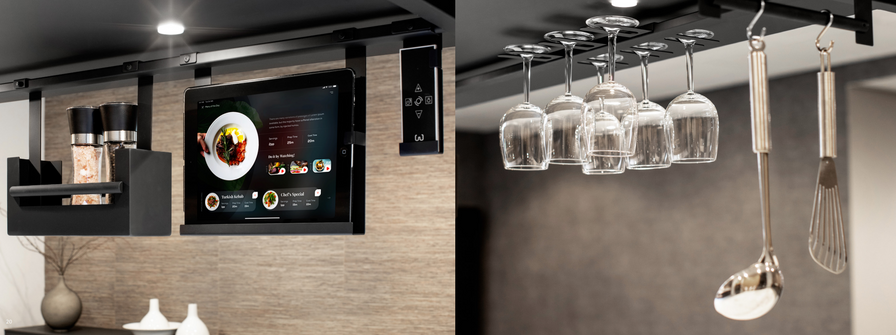
Bestel hier meteen accessoires voor je frame